Gratitude Is a Strategy
I’ve had the privilege of working with nonprofits since 2006. Some grow steadily, retain supporters, and build real momentum. Others constantly scramble—burning through donors, volunteers, and staff while wondering why it’s so hard to sustain progress.
The difference is rarely mission.
It’s rarely effort.
And it’s almost never passion.
It’s gratitude—operationalized.
Over time, I began to see a clear pattern. Some organizations treat their donors, sponsors, volunteers, and supporters as the lifeblood of the organization. Others—often unintentionally—treat them like a resource to be tapped when needed.
That distinction changes everything.
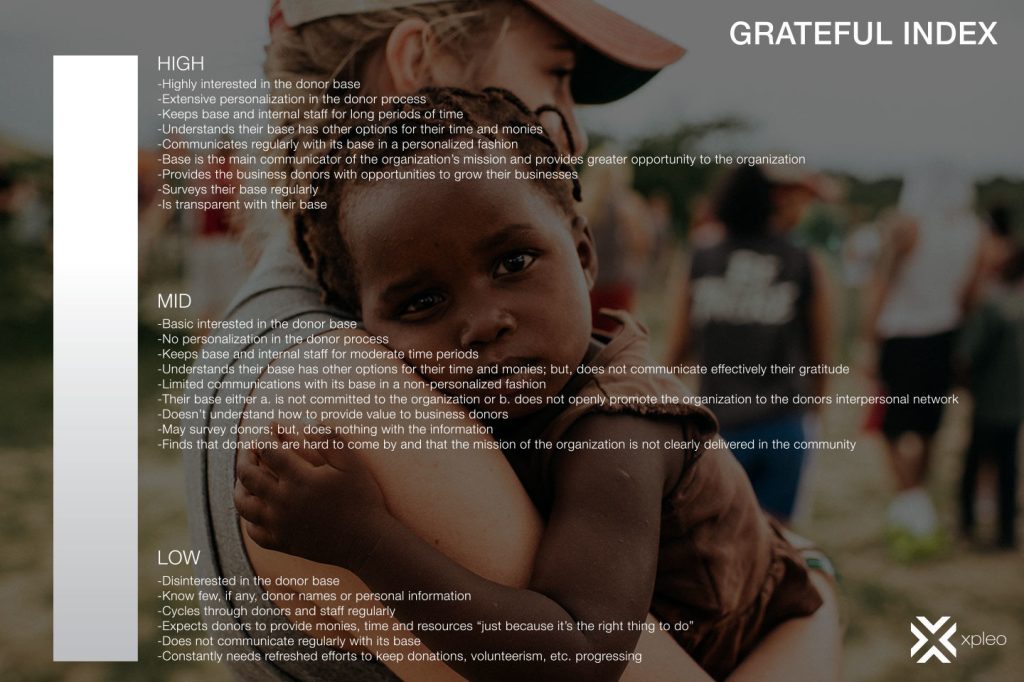
The Grateful Index
I started calling this pattern the Grateful Index.
It’s not about saying “thank you” more often.
It’s about how an organization views its base.
High–Grateful Index organizations steward their base.
Low–Grateful Index organizations extract from it.
And here’s the hard truth: organizations don’t usually realize when they’re slipping from high to low.
Complacency creeps in quietly.
The mindset shifts from:
“They choose us.”
to
“They should support us—it’s the right thing to do.”
That shift is where sustainability begins to break.
Low Grateful Index Behavior (And the Cost)
Low–Grateful Index organizations tend to see their base as dollars, hours, or deliverables.
Relationships are shallow.
Communication is transactional.
Engagement spikes only when something is needed.
Over time, the base gets depleted.
Like an apple tree stripped of every last fruit, the organization takes everything it can—without allowing anything to replenish the soil. Eventually, donors disappear, volunteers burn out, staff churn increases, and leadership scrambles to “refresh” messaging or find a new base.
The problem isn’t fundraising.
It’s erosion.
High Grateful Index Organizations Play a Longer Game
High–Grateful Index organizations understand something critical:
Every donor, sponsor, and volunteer has other options for their time, money, and energy.
They could spend that time with family.
They could support a different cause.
They could invest elsewhere.
That awareness shapes behavior.
High–Grateful Index organizations:
Communicate consistently and personally
Share stories that connect impact to people, not just outcomes
Ask supporters how they can be supported
Create opportunities for donors to grow, connect, and belong
Express gratitude in ways that feel human—not automated
As a result, they don’t just retain their base.
They grow it—organically.
The Real Indicator Isn’t Donations
Here’s what I’ve learned after years of watching nonprofits struggle and succeed:
Money isn’t the best indicator of organizational health.
Retention is.
Low–Grateful Index organizations constantly need new donors.
High–Grateful Index organizations rarely do.
That difference compounds.
A Leadership Gut Check
If you’re leading a nonprofit—or any organization that relies on people—ask yourself honestly:
How often do we thank our supporters without asking for anything?
How often do we tell their stories, not just ours?
Do we know our long-term supporters as people—or just as names in a database?
How often do we lose donors, volunteers, or staff and quietly normalize it?
When was the last time we created value for a donor, not extracted value from them?
These aren’t marketing questions.
They’re leadership questions.
This Isn’t Just About Nonprofits
The Grateful Index applies everywhere.
Customers.
Employees.
Partners.
Communities.
Any organization that treats people as interchangeable inputs will eventually pay the price—through churn, mistrust, and instability.
Gratitude isn’t soft.
It’s strategic.
The Question That Matters Most
Are you building an organization that people are proud to support—or one they quietly move on from?
Because in the long run, sustainability isn’t built on better campaigns.
It’s built on how deeply people feel seen, valued, and respected.
And that starts with gratitude—not as a sentiment, but as a discipline.